
What are striking distance keywords report?
Analyze keywords that are ranking close to the top of Google to prioritize quick-win opportunities that improve visibility and traffic.
Striking distance keywords refer to search terms where your website is just outside the first page or in less important, valuable positions in search results. These are usually between positions 5 and 20.
So, you can use some smart optimization strategies to push them in the top 3 positions organically, where they have a higher probability to rank in AI Overviews and be previewed in AI search results. Thus, it also helps with Answer Engine Optimization.
As AI search engines and Google AI Overviews are increasing, it has become increasingly important to secure a featured position in the first three results of Google.
Researchers say that if your site ranks number one in traditional SERPs, it has a 25% chance of being featured in AI Overviews. The higher you rank in Google’s top 10 pages, the better the probability you have to appear in AI search platforms like ChatGPT, Gemini, Perplexity, and Bing.
Importance of Optimizing Striking Distance Keywords
A positive shift in rankings, even by a few positions, can improve your visibility in traditional and AI-powered search engines. It even increases CTR to your site via chatbot citations.
Here's why you should consider optimizing with Striking Distance Reports:
AI Search Integration: Moving from position 8 to 3, or similar shifts to a higher position, increases your site's chance of being featured in AI Overviews and search results.
Cost-Effective Authority Building: Lesser efforts are required to optimize via Striking Distance Reports compared to highly competitive terms, yet the gains are substantial.
Extra Edge in SEO: Having strong positions for various related terms creates better chances to include them in AI-generated responses.
Quick Results: Unlike ranking new keywords, which can take months of effort, optimizing striking distance keywords correctly provides results within a few weeks.
Moreover, conventional rankings still have Significance as AI search engines often look up Google's top-ranking webpages. Yet it prioritizes the best answer to a particular question instead of the best page.
How To Use SERPView To Find Striking Distance Keywords
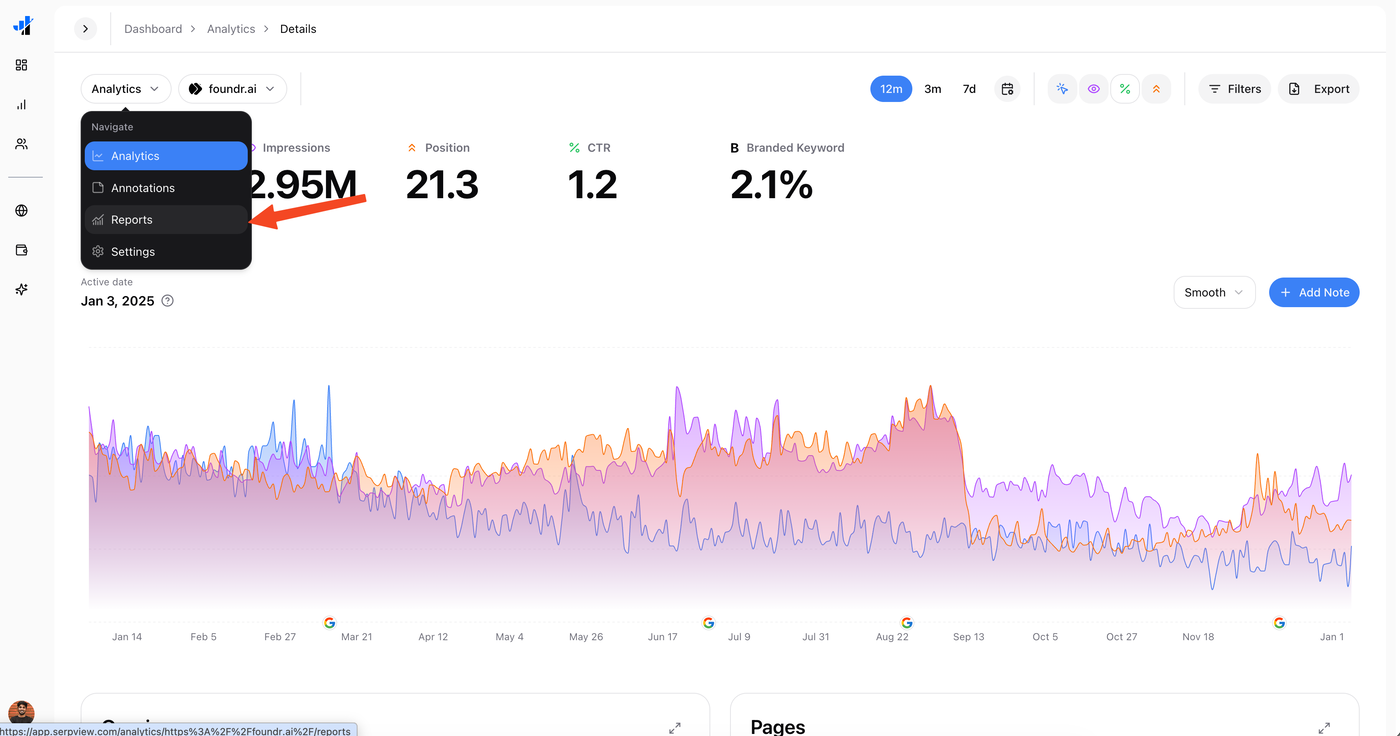
Log in to SERPView, select your site for which you want to check Analytics
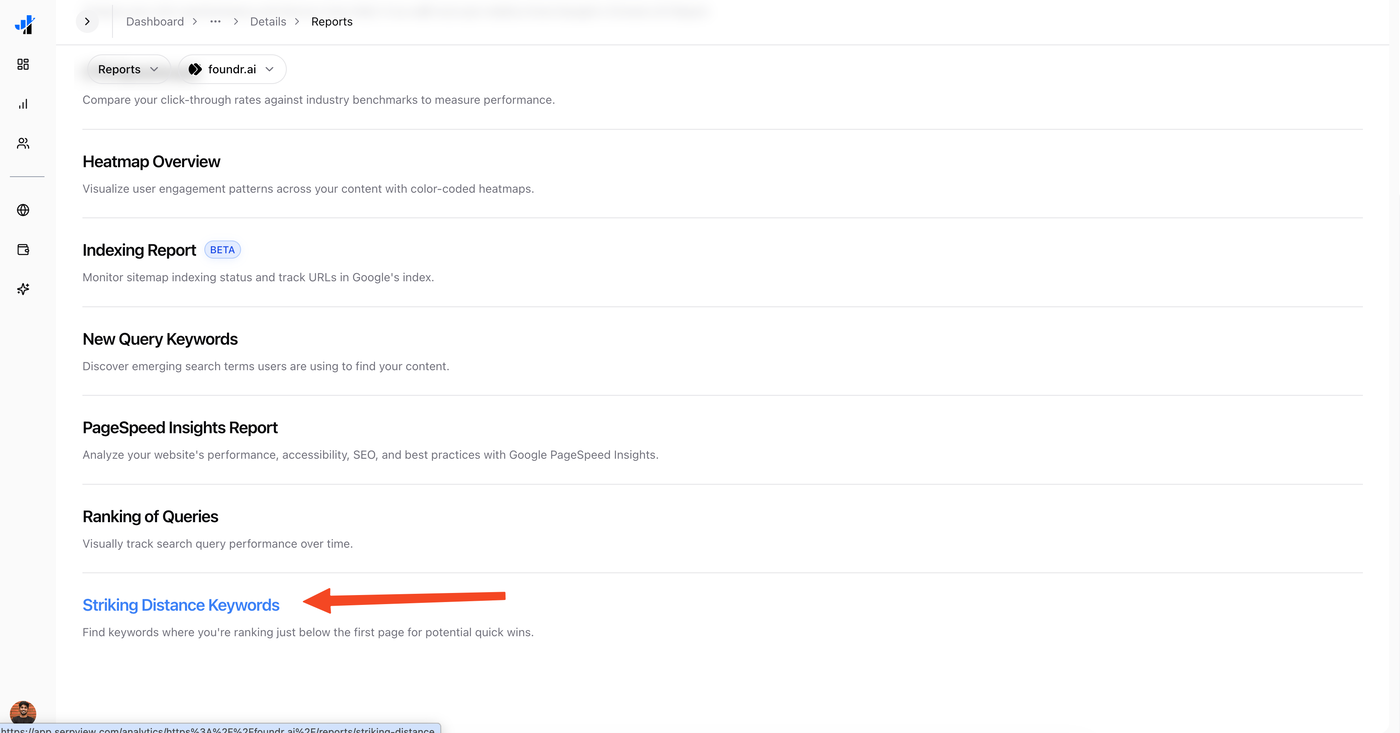
From the webpage with the graph, go to Reports > Striking Distance Keywords
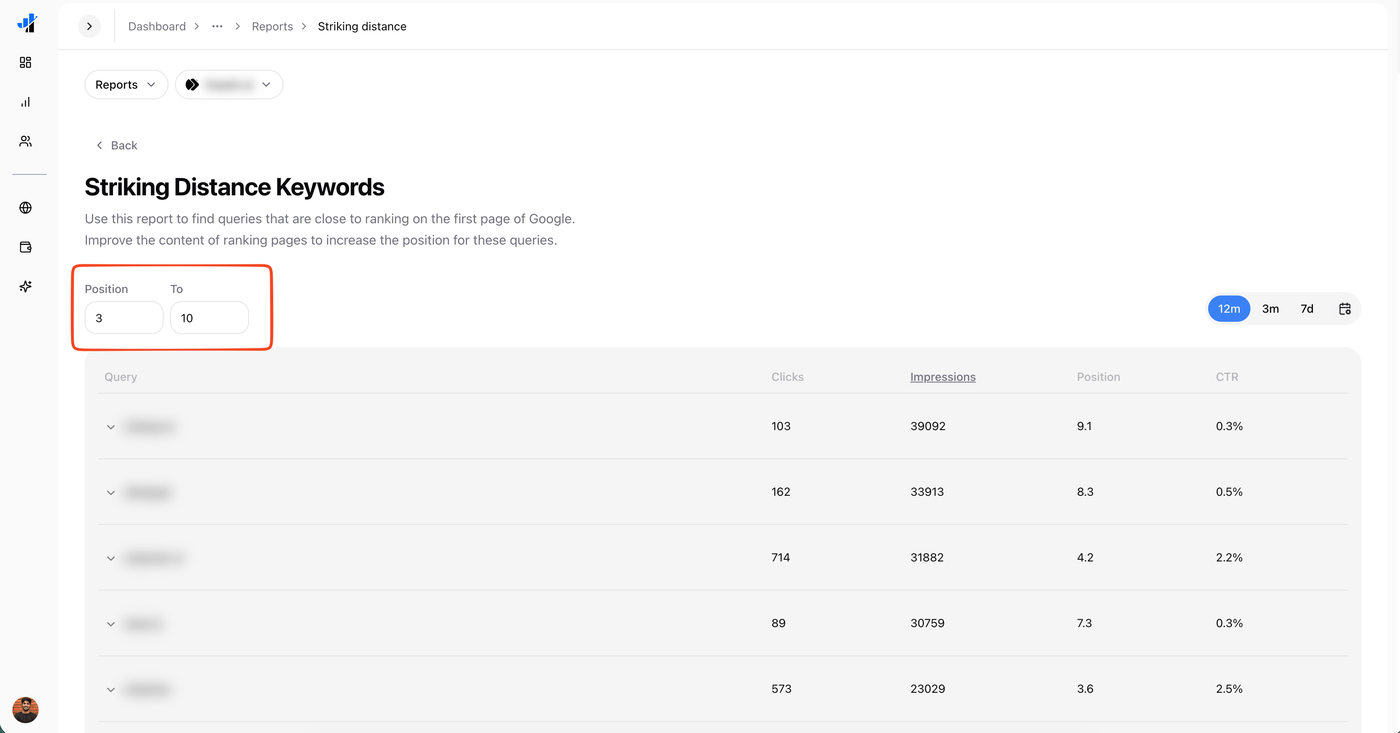
It displays the Striking Distance Reports. Further, you can filter the report by the position for which you want to check.
How to Prioritize Your Striking Distance Keywords?
Not all striking distance keywords are worth taking efforts for. Thus, follow our expert's strategies to identify the smart yet useful target.
Assess Search Volume: Prioritize keywords with a good search volume monthly. For example, a position 11 keyword having 1000 monthly searches has better potential than a position 12 keyword with 50 searches.
Competition Analysis: Identify the efforts required to rank on the first page of Google by:
Checking DA of competing websites.
Content quality and comprehensiveness of top results.
SERP features that can limit organic CTR.
Business Relevance: Check to what extent those keywords align with your goals, like:
Transactional keywords that depict buying potential often have the highest priority.
Informational keywords marketing funnel comes next to transactional.
Navigational keywords where users search for a particular brand usually have limited value until they are for a specific brand.
Current Performance: Always check how close you are to the first page of Google. It is because:
Position 11-15 keywords don't need as much work as those on 25-30.
Keywords that show positive growth with time are the ones on which you can grow and build momentum.
Seasonal Factors: Seasonal businesses or content sites should always focus on keywords that will be approaching their peak search period for maximum growth.
Most-Effective Striking Distance Keywords Optimization Strategies
After identifying and prioritizing striking distance keywords, you should focus on practical yet feasible strategies to move them to the top positions.
Intent-Focused Content Optimization
Always understand the user's intent. Like, rather than optimizing for the best page, focus on providing the best answer users need, a single answer to their question, instead of fluff.
Align With User Intent Correctly:
Informational Queries: Give comprehensive answers to users early in your content, like at the beginning.
Commercial Queries: Add clear comparisons, benefits, tops, and more that are helpful for the user.
Transaction Queries: The conversation process should be less obvious.
Answer the Question Directly: Add the most relevant answer from your article in the first 100-200 words.
Use a Proper Structure: Organize all the content with descriptive headings that align with user intent, addressing it without any fluff. Thus, users and AI both could identify useful information.
Content Enhancement Based on Top Performers
Analyze Top 3 Results: Check which sites are ranking in positions 1-3 for the focus keyword. Further, cross-verify it for questions like:
Which questions are they answering and how?
What format are they using? Are they lists, comparisons, or steps?
What information are they missing that you can include to outshine competitors?
Fill Content Gaps: Include information where your competitor pages lack coverage, yet focus on what's relevant to the user intent.
Improve Readability: Use short paragraphs, clear subheadings, and bullet points such that it's easily skimmable.
On-Page Optimization for Intent
Title Tag Optimization: Use titles that directly answer the user's question.
Use Your Target Keyword Naturally: Directly address the particular intent using “How to,” “Best,” “Compare” that aligns with the user. The length of the keyword should be less than 60 characters.
Header Optimization: Write headers to structure your answer suitably.
H1 directly answers the main query.
H2 and H3 should answer related sub-questions.
Add variations of target keywords naturally.
Meta Description: Use descriptions that provide a clear answer to the user’s question and increase CTR.
Internal Linking for Authority
Link from Related Content: Use internal links from other relevant links on your website to improve the authority of webpages.
Write Descriptive Anchor Text: Link with text that describes what users get, and integrate relevant keywords naturally.
Create Content Clusters: Write related content that supports your main target page and link it strategically.
Measure Success and Timeframes
Track how suitably the striking distance keyword optimization is performing during this time, watch these metrics:
Ranking Position Changes: Directly measures your optimization's success rates.
Further monitor them for:
Weekly position changes for all the target keywords.
Calculate how many keywords have moved up and down to and from page one.
Check the average position performance for all keywords.
Organic Traffic Boost: Measure how it has impacted actual visitors by:
Compare traffic to optimized pages.
Check traffic patterns as per the landing page.
Separate new vs returning visitors.
Click-Through Rate Improvements: As rankings boost, the CTR should grow:
Analyze CTR before and after optimization efforts.
Benchmark against industry averages for various positions.
Check patterns across title/description changes and CTR improvements.
Conversion Metrics: Check business impact for:
CTR changes on optimized pages.
Check additional revenue or leads generated.
Measure the impact on engagement metrics, such as time on page.
Striking Distance Reports delivers an incredible performance boost for websites, and we have personally verified this on our own. Thus, for those chasing long-term progress in a short time, you must go for it! SERPViews makes it easier and quicker to check!